

Commercial Calf Rearing Equipment for Dairy Farms
Choose calf housing, colostrum-handling equipment, feeding tools and electric milk taxis for a coordinated rearing routine. NexAgri supplies commercial dairy farms, distributors and livestock projects with equipment selected around calf numbers, feeding workflow and housing layout.
Why Commercial Dairies Choose Our Equipment Standard
NexAgri coordinates product selection, quality inspection, customization, and export delivery for commercial calf rearing projects.
For farm and distributor orders, define product quantities, dimensions, material requirements, OEM/ODM customization and export documentation in the quotation.
Advanced Agricultural Materials
The housing range combines rotational-moulded PE calf hutches with galvanized steel pen enclosures. Match hutch dimensions, ventilation openings and pen layout to the farm’s climate and cleaning routine.
Hygienic Design Protocols
Moulded hutch surfaces and removable pen sections provide access for cleaning and bedding changes. Include joints, drainage points and feeding equipment in the between-group cleaning routine.
Calf Housing and Isolation Equipment
Plan housing around the calf-rearing routine. Define pen spacing, ventilation, bedding, drainage, cleaning access and animal-contact arrangements with the farm team.

Outdoor Calf Hutches
- One-piece rotational-moulded PE construction provides a continuous interior surface for routine washing.
- Adjustable rear vents support airflow through the hutch, with a UV-stabilized PE option for outdoor exposure.
- Individual hutch-and-pen arrangements provide separate calf spaces with access for feeding, bedding and cleaning.

Heavy-Duty Pen Enclosures
- Reinforced steel structure, hot-dip galvanized after welding for high corrosion resistance against manure and moisture.
- Specify smooth, deburred welds and inspect edges and openings before use.
- Quick-release pin latches facilitate fast disassembly for batch sanitation and bedding management.
Colostrum Management Equipment
Organize colostrum preparation, storage and feeding equipment. Select capacity, containers and handling interfaces for the farm colostrum-management protocol.

Colostrum Pasteurizer
The listed colostrum pasteurizer uses an approximately 60°C, 60-minute cycle. Confirm temperature control, batch size and cleaning requirements in the model documentation; the farm and its advisers should validate the handling procedure for actual colostrum conditions.

High-Efficiency Colostrum Bags
Multi-layer colostrum storage bags support freezing and warming workflows. Choose bag capacity and connectors for the feeding system, and follow the selected bag’s temperature and reuse instructions.

Esophageal Feeding Probes
Feeding probes are supplied for trained personnel working under the farm veterinary protocol. Match probe size, tip material and connectors to the selected feeding equipment, and follow the model’s administration and cleaning instructions.
Calf Feeding Equipment for Commercial Dairy Farms
Specify feeding tools for the daily routine. Match vessel capacity, teat type, flow and cleaning access to the farm feeding plan and operator workflow.

Ergonomic Calf Nursing Bottles
Capacities: 2L / 3L / 4LChoose 2 L, 3 L or 4 L nursing bottles with handles and teat assemblies for individual feeding. Select teat flow and replacement parts around the feeding programme and cleaning routine.

Group Feeding Feeder Buckets
Capacities: 4L to 55L (1 - 12 Teats)Group feeder buckets span 4–55 L with 1–12 teats. The 38 L buckets come with 6 teats (HL-MP70C-1) or 8 teats (HL-MP70D-1). The 55 L bucket (HL-MP70E) has 12 teats. Match capacity, teat count and valve options to group size, cleaning access and the farm’s method of monitoring individual intake.

Anti-Sucking Weaning Devices
Fit & Welfare ChecksPP weaning devices are available for managed group-rearing routines. Select the model and fit with qualified advice, and include regular inspection in the farm welfare protocol.
Electric Milk Taxis and Mobile Calf Milk Mixers
Plan mobile mixing and distribution for the feeding route. Confirm batch size, route surface and gradients, charging, heating and dispensing requirements for the selected milk taxi.
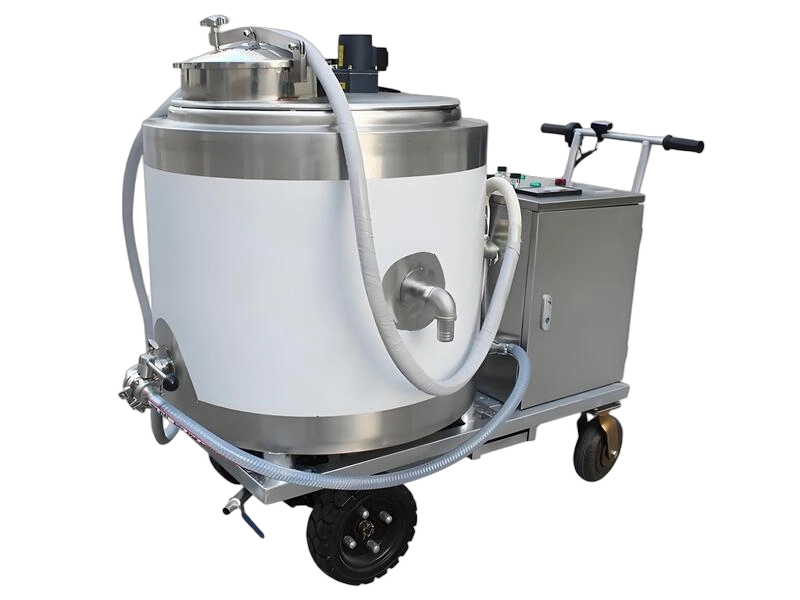
Mobile Mixing & Dispensing
-
Self-Propelled Drive System
A 300 L tank and battery-assisted drive support mobile feeding rounds. Size the route around payload, gradients, surface conditions, battery runtime and charging access.
-
Integrated Agitation & Heating
Specify heater and agitator capacity for the batch volume, starting temperature and milk-replacer preparation instructions. Verify mixing and temperature performance under the intended conditions.
-
Pre-Set Flow-Dosing Gun
A preset dispensing gun supports planned portions. Confirm dispensing range and calibration with the actual liquid and feeding routine.
Calf Jackets & Care Equipment
Match equipment to the farm care plan. Specify jacket size and insulation for the housing conditions, and review emergency equipment with the responsible veterinary team.

Thermal Winter Calf Jackets
600D Oxford fabric, 350g insulation and belly straps form the winter calf jacket. Select the size for the calf and housing conditions, and inspect fit, dryness and fastening during use.

Emergency Aspiration Respirators
The aspiration device combines an aluminum barrel and rubber cup. The veterinary team should select the appropriate size and intended use, with trained operators following the product’s operating and cleaning instructions.
Engineered for Diverse Operational Climates
See calf-housing and feeding installations selected for different climates and daily care routines.

Siberia, Russia
Commercial Dairy Enterprise (2,000 Head)
"Deploying outdoor hutches paired with thermal calf jackets has improved winter survival and calf vitality. The rotational-molded PE remains structural without cracking down to -30°C."

Dubai, UAE
Desert Dairy Facility
"The opaque white PE shell reflects high solar radiation while rear ventilation ports maintain air movement, helping young stock maintain feed intake during extreme summer heat."
Calf Rearing Equipment FAQs
Practical equipment-selection and operating answers for commercial dairy calf-rearing projects.
How many calf hutches should a farm plan for?
Calculate the requirement from the calving pattern, pre-weaning period, cleaning turnaround and the intended spare capacity between batches. Share those inputs with NexAgri so the hutch and pen quantity can be matched to the facility routine.
What housing materials are used for calf hutches and pen enclosures?
The range includes rotational-molded PE hutches and steel pens with listed hot-dip galvanizing. Confirm material, UV and coating specifications and any required documentation for the selected item, climate, layout and cleaning method.
What calf feeding equipment capacities are available?
The listed nursing bottles are available in 2 L, 3 L and 4 L sizes. Group feeder buckets are listed from 4 L to 55 L with 1 to 12 teats. Choose capacity and teat count from the group size and daily feeding programme.
Can the electric milk taxi support large feeding rounds?
The 300 L electric milk taxi combines battery-assisted drive, agitation, heating and a preset dispensing gun for mobile calf-feeding rounds. Match batch volume, charging requirements and dispensing settings to the feeding route.
How is colostrum handled on this calf-rearing system?
The listed equipment includes an approximately 60°C, 60-minute colostrum pasteurizer, storage bags and feeding probes. Confirm model-specific instructions and validate the farm handling procedure with qualified advisers. Feeding probes require appropriate training and veterinary guidance.
Get Your Custom Calf Rearing Configuration Plan
Tell us the calf group size, equipment types and quantities you need. For feeding bottles and group buckets, specify capacity, teat type and replacement parts. For a milk trolley, describe the batch volume, feeding route, power supply and cleaning routine. NexAgri can review a B2B equipment configuration and quotation for your destination.
Share what you know. If a detail is undecided, ask us to recommend an option.
Helpful details for your enquiry
- Bottles
- 2 L, 3 L or 4 L; teat and spare-part requirements.
- Group buckets
- Required working volume, number of teats and group size.
- Milk trolleys
- Review 150 L and 300 L configurations separately; specify mixing, heating and dispensing requirements.
- Order details
- Equipment quantities, destination country and cleaning requirements.
Equipment configuration and supply scope are confirmed in the quotation.