
High feed costs eating into your profits? You see cheap local by-products go to waste, knowing there must be a better way to use them on your farm.
Yes, by properly fermenting local by-products like brewer's grains with dry ingredients. This creates a stable, nutritious silage that replaces expensive feeds. For a 1,000-cow farm, this method can easily save over $100,000 a year in feed costs alone.

I've spent years helping farms, big and small, tackle the challenge of feed costs. One of the most effective strategies I've seen is turning cheap, local resources into high-quality feed through mixed silage fermentation. It seems simple, but getting it right is key to unlocking those huge savings. I have seen firsthand how a farm can transform its profitability with this technique. Let’s walk through the five core steps I share with every farm manager looking to make this change.
What are the core principles for using local feed ingredients?
Eager to use cheap local feed? But using the wrong materials can harm your herd and your wallet. There’s a safe, smart way to source your ingredients.
Prioritize safety, nutritional balance, and a stable supply. Never use spoiled or contaminated materials. Always test ingredients to create a balanced mix and choose suppliers within 200km who can provide consistent volume. This prevents herd stress from frequent diet changes.

When I work with a new farm, the first thing we discuss is not just finding cheap feed, but finding the right feed. It's easy to get excited about a low price, but that can lead to big problems. I always advise following three simple rules.
First, safety is number one. Never, ever use ingredients that are already moldy, smell rotten, or could be contaminated with heavy metals or pesticides. The small amount you save is not worth risking your herd's health.
Second, think about nutritional balance. A cheap by-product isn't useful if it unbalances your ration. Before each batch, you must get a basic analysis of its dry matter, protein, and fiber. This data helps you mix it correctly with other feeds.
Finally, ensure a stable supply. It's best to find a source within 200km that can offer a large, consistent supply, either year-round or seasonally. This allows you to create a stable diet for your cows and avoid the stress and production drops that come with frequent feed changes.
How do you create the perfect scientific mix for silage?
You have your ingredients, but just throwing them together won't work. Improper moisture levels can lead to spoilage and wasted effort. Getting the recipe right is everything.
The key is managing moisture and providing enough sugar for fermentation. Mix high-moisture ingredients (like fruit pulp) with dry ones (like straw or bran) to achieve a total dry matter of 35-45%.1 Add bran or molasses if your mix lacks natural sugars.2

The success of your mixed silage all comes down to the recipe. The goal is to get the final dry matter (DM) of the mixture between 35% and 45%. If it's too wet, it will spoil. If it's too dry, it won't pack well or ferment properly. For example, brewer's grains can be 80% water (20% DM). To use them, you must mix them with a dry ingredient like corn flour or beet pulp.
Some ingredients, like brewer's grains, are high in protein but low in the sugars that lactic acid bacteria need for good fermentation. In these cases, adding something like molasses or bran provides the necessary fuel for the fermentation process. I also recommend spraying a fermentation inoculant during mixing. This helps good bacteria grow, stops mold, and makes the final feed easier for the cows to digest.
Here are some real-world examples from farms I have worked with:
Farm 1: Tomato Peel Base (Final DM 37%)
| Ingredient | Dry Matter | Mixing Ratio |
|---|---|---|
| Tomato Peels | 15% | 70% |
| Corn Flour or Bran | 88% | 30% |
Farm 2: Orange Pulp Base (Final DM 36%)
| Ingredient | Dry Matter | Mixing Ratio |
|---|---|---|
| Sweet Orange Pulp | 15% | 80% |
| Cassava Flour | 90% | 25% (of wet pulp) |
| Wheat Straw | 90% | 5% (of wet pulp) |
Farm 3: Brewer's Grains Base (Final DM 41%)
| Ingredient | Dry Matter | Mixing Ratio |
|---|---|---|
| Brewer's Grains | 20% | 70% |
| Corn Flour | 88% | 20% |
| Bran or Beet Pellets | 90% | 10% |
Farm 4: Sugarcane Leaf Base (Final DM 42%)
| Ingredient | Dry Matter | Mixing Ratio |
|---|---|---|
| Sugarcane Leaves | 35% | 60% |
| Fruit Pulp | 15% | 20% |
| Cassava Dregs | 90% | 20% |
What are the best practices for silo setup and sealing?
You've mixed your feed perfectly. Now, poor storage can ruin it all. Compaction and sealing are where many farms fail, leading to mold and massive losses.
Use a bunker silo with concrete walls and a sloped, hardened floor for drainage. Pack the material tightly. For soft mixes, pat it down with shovels to about 2 meters high. Seal immediately with two layers of film and weigh it down with tires.

Your storage setup is just as important as your feed mix. The ideal setup is a bunker silo with three concrete walls and a hard, concrete floor. The floor should have a slight slope of 1% to 2%. This is critical because it allows any excess liquid to drain away instead of pooling at the bottom and spoiling the feed.
Once your ingredients are mixed, get them into the silo and packed as quickly as possible. The goal is to remove all the air. For many mixes, you can use a heavy tractor to drive over it repeatedly. However, some materials like wet brewer's grains are too soft and mushy for a tractor to compact effectively. In my experience, the best method for this is to have your team use shovels to pat the material down firmly. Pack it to a height of about 2 meters.
As soon as it's packed, seal it. Use a layer of thin, clear film first, then cover it with a thicker black-and-white plastic sheet. Overlap the edges and cover the entire surface with old tires, making sure they are touching. This weight keeps the plastic down and maintains an airtight seal.
A quick warning: if you are processing more than 300 tons at once, do not use your TMR mixer for mixing. It will take too long, and the extended exposure to air will ruin the quality of your fermentation before it even starts.
How can you tell if your fermentation was successful?
The silo is sealed and you've waited. Is the feed inside valuable nutrition or a spoiled mess? Knowing what to look for is crucial before you feed it.
After about a week in summer, you can check. Good silage is yellowish-green or reddish-brown, soft, and smells fruity or like sweet grains.3 It should feel moist but not drip water when squeezed. The pH should be between 4.0 and 4.5.
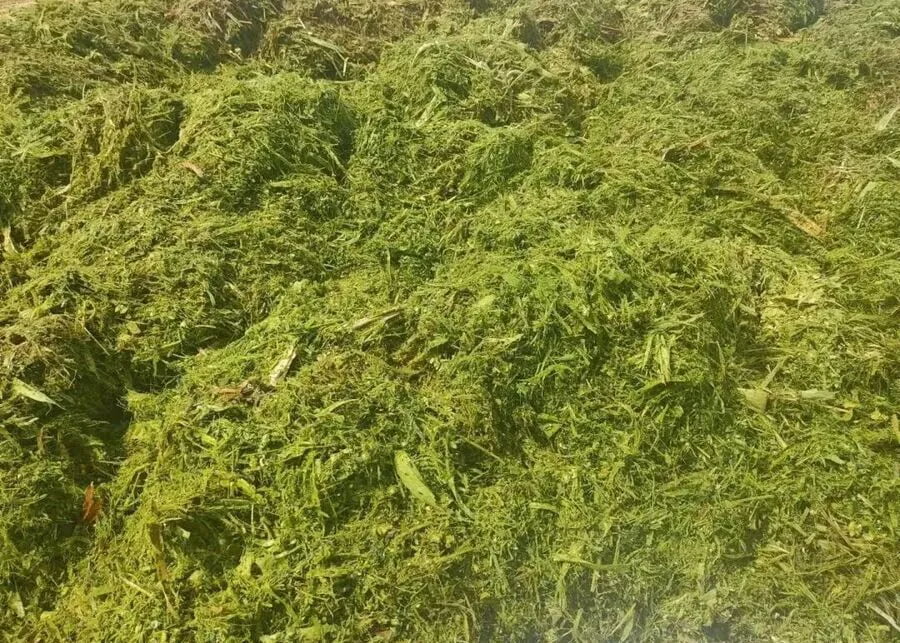
After all your hard work, the moment of truth arrives when you open the silo. In warm summer months, the fermentation process can be complete in as little as seven days. The first thing you'll notice is the look and smell. High-quality fermented feed should have a pleasant, slightly sweet smell, like fruit or brewer's grains. The color should be a consistent yellowish-green or even a reddish-brown. Avoid anything that smells sour, moldy, or rotten, or looks black or slimy.
Next, do the squeeze test. Grab a handful and squeeze it tightly in your fist. It should feel soft and moist, and it might hold its shape when you open your hand. But, it should not drip water. If water runs out, it was too wet. If it falls apart and feels dry, it was too dry to ferment well.
For a more scientific check, use a pH meter. A successful fermentation will bring the pH down to a range of 4.0 to 4.5. This acidity is what preserves the feed and prevents bad bacteria from growing. When you start feeding from the silo, always make sure to keep the face of the silage pile clean and straight to minimize exposure to air and prevent spoilage.
How does this all translate into real cost savings?
You've done the work, but what's the real financial payoff? The numbers might surprise you. This isn't just about saving a few dollars; it's a major financial strategy.
By replacing expensive hay and concentrates with 5-10 kg of this mixed silage per cow daily, you can cut feed costs by $0.20-$0.30 per cow per day. For a 1,000-cow dairy, that adds up to over $100,000 in savings every year.

This is where all the effort pays off on your balance sheet. Let's use brewer's grains as an example. You can buy and store them when they are cheap and plentiful. By mixing them with a cost-effective dry ingredient like bran or beet pulp, you lock in that low price. But the savings don't stop there. The fermentation process actually makes some nutrients more digestible. For instance, the starch in any corn flour you mix in becomes easier for the cow to use.
A nutritionist can then reformulate your ration. By adding 5 to 10 kg of this high-quality mixed silage to each milking cow's daily diet, you can replace an equivalent amount of more expensive dry hay or protein supplements, without losing any nutritional value. This simple substitution can lower your daily feed cost by $0.20 to $0.30 per cow.
It might not sound like much, but let's do the math. For a farm with 1,000 milking cows, saving just $0.27 per cow per day ($0.27 x 1,000 cows x 365 days) adds up to $98,550 in one year. I've seen farms save well over $100,000 annually. It is one of the most powerful ways to reduce your input costs and increase farm profitability.
Conclusion
By following these five steps for mixed silage, you can unlock significant feed cost savings, improve herd nutrition, and boost your farm's bottom line.
"Effects of Moisture Content Gradient on Alfalfa Silage Quality, Odor ...", https://pmc.ncbi.nlm.nih.gov/articles/PMC11858379/. This source discusses optimal dry matter levels for silage fermentation and the role of ingredient moisture balance. Evidence role: mechanism; source type: education. Supports: Achieving a dry matter level of 35-45% is crucial for successful silage fermentation.. Scope note: Specific dry matter percentages may vary based on regional practices and ingredient types. ↩
"Effects of Sugar Cane Molasses Addition on the Fermentation ... - PMC", https://pmc.ncbi.nlm.nih.gov/articles/PMC7912638/. This source explains the importance of adding sugars like molasses to silage mixtures to support fermentation. Evidence role: mechanism; source type: education. Supports: Adding sugars like molasses to silage mixtures supports fermentation by providing fuel for lactic acid bacteria.. Scope note: The effectiveness of added sugars may depend on the specific bacterial strains used in fermentation. ↩
"Determine the characteristics of good silage and the steps in ...", https://forages.oregonstate.edu/nfgc/eo/onlineforagecurriculum/instructormaterials/availabletopics/mechanicalharvest/silage. This source describes the physical and sensory characteristics of high-quality silage, including color, texture, and smell. Evidence role: definition; source type: education. Supports: High-quality silage is characterized by a yellowish-green or reddish-brown color, soft texture, and fruity or sweet smell.. Scope note: Characteristics may vary slightly depending on the ingredients used in the silage. ↩

